Pastor Seaton authored the following article back in 1985 and covers a small bit of the many questions that arose within the church in 1970-72 as our church was being formed. Now, of course, it is part of the Inverness Reformed Baptist Church’s history. However, all these years later it is one of the problems small church’s still have to deal with is where to worship.
Dear Friends,
One of the major concerns for small churches today is to find suitable premises to accommodate the church’s work and worship. Very often the first consideration is an existing. “Church building” which, hopefully, can be purchased at some reasonable cost and then renovated, where renovations are in order. In the experience of many, however, this course has turned out to be beset with a good few problems and, whereas, the initial purchase price may be low, the cost of renovation and upkeep turns out to be extremely high. As a small church ourselves had to face the question, we thought that it might be of practical help to pass on our own experience and the course we adopted.
At the foundation of the church in November 1970, we worshipped in a local Funeral Parlour, but felt a move was desirable! A local “Church building” went on the market about that time, seating around six hundred, and in need of some repair. The cost turned out to be prohibitive, anyway, but it became apparent to us that the last thing that we really needed was a church building seating six hundred people.
We began to get down to some basics, and as the old saying goes, began to “cut our suit according to our cloth.” Eventually we come across two very “utility” looking wooden buildings – optimistically advertised as “bungalows.” They sat in a good large piece of ground, so we paced them out and peered through the windows. 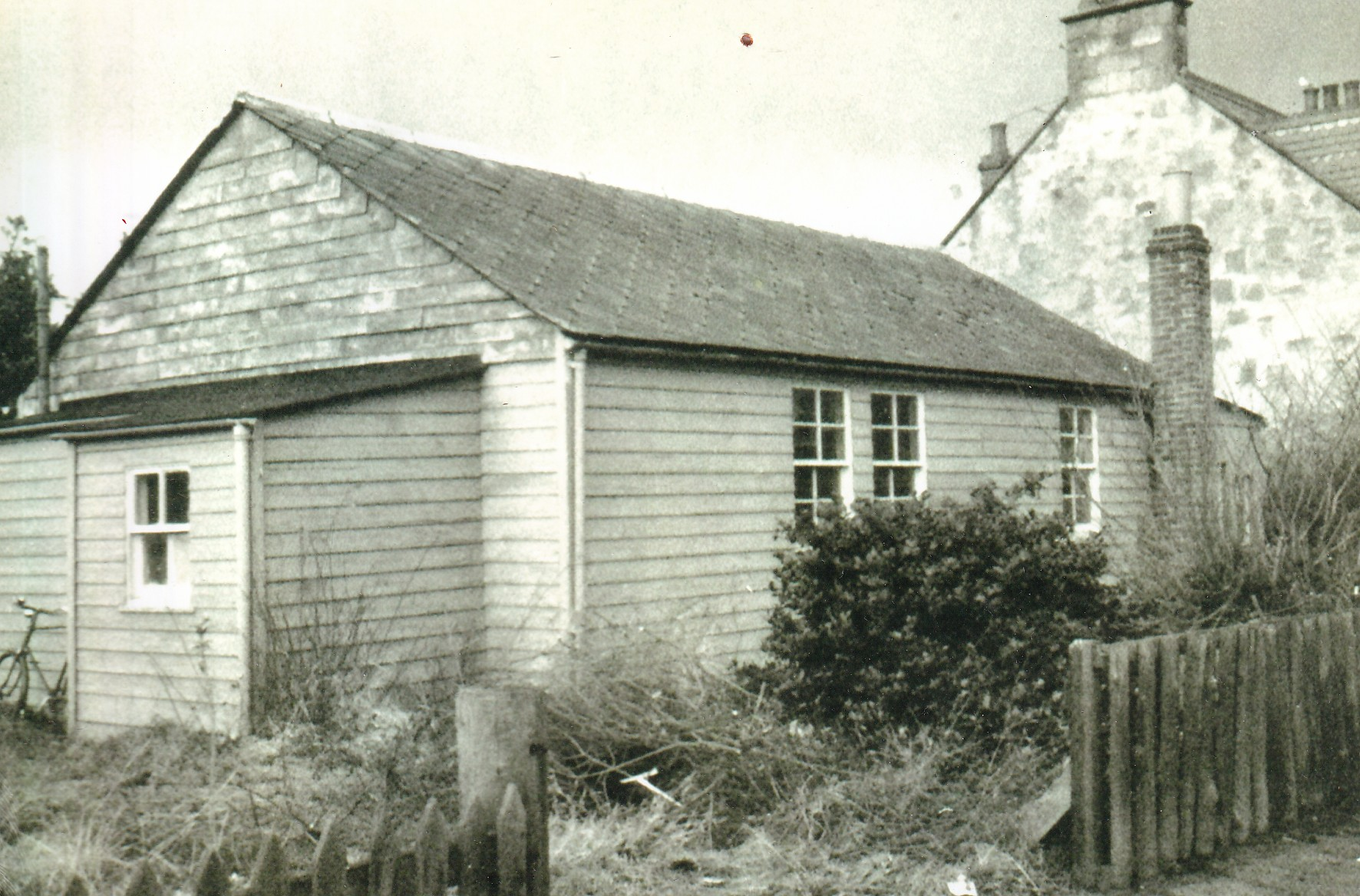 The larger of the two buildings which we thought might be suitable for a place of worship, measured 36 ft long by 22 ft wide, with a small porch at the front and a lean-to extension at the back. There were six small rooms in the main part of the building, and two in the extension. Thirty-six feet by twenty-two is not a large area, but after some rough calculations it was reckoned that if we could suitably remove the room partitions we would be left with an area quite ample for our use. We made application and our bid was accepted.
Into the 36x22 foot floors pace we are able to fit nine pews nine feet long from either side of the building, thus leaving a centre aisle of 4 ft. These eighteen pews in all seat 108 people and with an average congregation at present of around 70 this is quite sufficient, and very conducive in many ways. This should be one of the main considerations for any small church. What does a congregation of between twenty and thirty want with a building that hold six hundred! The best point to aim at is a building small enough so that it will not be a burden on the congregation, but large enough to allow an increase in congregation as the Lord might grant it.
As a congregation begins to out-grow such premises, then presumably, it will also be able to undertake something larger or add an extension, as the case might be. It’s surprising, however, what “bursting point” would entail anyway. In our own case, we have in front of the pews the area that accommodates the pulpit, the organ, and the small communion table that we use. Around a dozen to twenty chairs can be fitted in that area. In a four foot wide aisle one chair can be placed at the end of each pew on one side; and, again in our own case, having built on a vestibule and toilet are in place of the old porch mentioned, we can seat another fifteen or twenty people, as the wide doors open onto the main worship area.
A brief tally of those figures will show that around 150 can be seated and accommodated. Some might think it could be a wee bit crushed at that, and that could be a bit of a drawback! And as I’ve said, once the Lord has filled a church’s place of worship to bursting point, then it would appear that an extension or such like could be undertake with such an increase. The simple point we would make to churches in need of premises is, don’t confine your thoughts to a building with a steeple and stained-glass windows. It is not a “Church building” that is required, it is a building for the church. Such premises that will enable a local church of Christ in its area to function and grew to the praise of God.
There are two determining factors considering church accommodations: (1). That we must try and be good stewards. (2) That we must try and do all things decently and in order. The first will guard us against needless extravagance, the other will keep us from being tawdry. It is amazing how dignified we can be when we keep within our budget, and, at the same time, endeavour to do all that we can with what we have to the honour and the praise of Christ.
We write these words sincerely, and experimentally. In taking the above course, we are thankful to say that we have never lacked, and as we began we still continue. Over the years since we moved into the buildings we have adopted the same practice. Perhaps a recent word in our sermons in Exodus applies in its own Israel Canaan, “little by little.”
Once we had done all the necessary renovation work, we then were able to instal a warm air heating system, and in more recent times have turned the second of the two buildings into a Christian Lending Library, which also houses the Bible Classes, and the Prayer meeting in the mid-week. The biggest changes – as far as our original wooden buildings are concerned – are external. Both buildings were eventually re-roofed, and both have been “harled.” Harling is that system of turning a wooden exterior into a cement one. It is not an expensive process, and once done, it is impossible to tell that the original walls were ever made of wood. With just a wee bit of thought, and a good dose of sanctified common-sense, you normally find that there is a way to do something that will prove less expensive and yet perform the same function.
Being a Baptist church, we, of course, required a baptistry in the building. We decided to place it at the place where the old kitchen of the house had been; that’s where the water already ran. We made some enquiries about the cost of baptistries; they were expensive. Realising that all that we needed was a “tank” in the ground to hold water, we simply dug down the appropriate depth and built in a concrete (water-tight) box. A set of steps leads into it, and it is emptied after each baptism via a small pump.
These aspects of our own experience and practice we simply leave on record for any who can benefit from them. I’m sure we would have been happy if someone had jogged our own minds along certain lines when we were endeavouring to “make do and mend.” If the few thoughts are of use to any smaller churches, then we surely rejoice in that. There are numerous other things that we might relate, but it’s part of the joy of it all in our own particular situations to find means of doing things that suit us best. In the overall, however, there are certain advantages that cannot be measured: the business of upkeep and repairs, for example. Remember how heating and lighting costs have increased, and will probably continue to do so. There are so many advantages; and above all, of course, there is the opportunity to spread the gospel more freely. If you are a small church at this time looking for a place of corporate work and worship, we would simply say, don’t overlook anything!
Editor’s note. It is now over 50 years since we began to worship here in Telford Road, and we still give thanks to God for giving us these premises so that we as a church may gather one with another and worship His holy name.
“The beginning of true nobility comes when a man ceases to be interested in the judgement of men, and becomes interested in the judgement of God.” J. Gresham Machen.