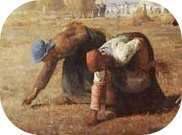
Verse 14. “He causeth the grass to grow for the cattle, and herb for the service of man: that he may bring forth food out of the earth … and bread which strengthens man’s heart.” Everybody – the child and the old man, the beggar and the king – like bread. We may remember the unfortunate man, who was cast on the desert isle, famishing with hunger, and who cried at the sight of a handful of gold, “Ah, it is only gold!” He would willingly have exchanged this, to him, useless material, for a handful of bread. O let us never sin against God by lightly esteeming his bread. Let us gratefully accept the sheaves we gather, and thankfully visit the barns that preserve them. Let us never sit down at the table without asking God to bless the gifts we receive from His gracious hand and never eat bread without thinking of Christ our Lord, who calls Himself the living bread who came down from heaven to give life to the world. And above all, may we never go to the table of the Lord without enjoying, through the symbols of the bread and wine, His body and blood, whereby we receive strength to nourish our spiritual life. Yes, Lord, thou satisfieth both body and soul, with bread from earth and bread from heaven. Praise be to thy holy name, or hearts and mouths shall be full of thy praises for time and for eternity.
Verse 21. “The young lions roar after their prey, and seek their meat from God.” God feeds not only sheep and lambs, but wolves and lions. It is a strange expression that young lions when they roar after their prey, should be said to “seek their meat from God;” implying that neither their own strength nor craft could feed them without help from God. The strongest creatures left to themselves cannot help themselves. As they who fear God are fed by special providence from God, so all creatures are fed and nourished by a general providence. We may think a lion might shift for himself; but no, ‘tis the Lord that provides for him – the young lions seek their meat from God. Surely, then, the mightiest of men cannot live upon themselves. As we receive from God life and breath, so we must receive from God all things needful for the maintenance of this life.
Verse 24. “O Lord, how manifold are thy works …” They are not only for number, but manifold for variety. Mineral, vegetable, animal – what a range of works is suggested by these three terms. No two men, even of the same class, are exactly alike, and the classes are more numerous than science can number. Works in the heavens above, and in the earth beneath, and in the waters under the earth. Works which abide the ages; works which come to perfection and pass away in a year; works which with all their beauty do not outlive a day. Works within works, and works within these again – who can number one of a thousand? They are all His works – wrought by His own power, and they all display His wisdom. They are all wisely made – each one fits into its place, fills it, and is happy in so doing. “The earth is full of thy riches.” It is not a poor-house, but a palace. And if His house below is so full of riches, what must His house above be?
Verse 25. “So is this great and wide sea, wherein are things creeping innumerable … leviathan, whom thou hast made to play therein.” Fish, great and small, sport and play in the element of water; but as soon as they are brought out of it they languish and die. Mark, O soul, what the element is if thou wouldest live joyful and blessed.
Verse 35. “Let the sinners be consumed out of the earth, and let the wicked be no more. Bless thou the Lord, O my soul. Praise ye the Lord.” This is the first place where hallelujah (Praise ye the Lord) occurs in the Book of Psalms. It is produced by a retrospect (looking back) on the works of creation and by the contemplation of God’s goodness in the preservation of all the creatures of his hand; and also – by a prospective (looking forward) view of that future Sabbath, when, by the removal of evil men, God will be enabled to look on His works, ad he did on the first Sabbath, before the Tempter had marred them, and see “everything very good.”